

It was designed to reveal how I think. Years ago, I had an idea. Instead of building a portfolio that stacked disconnected work into neat categories, I wanted to create something immersive, a brand that didn’t exist yet, but felt like it could. A product that wasn’t real, but was thought through as if investors were about to ask hard questions.
At first, I considered calling it Summit. It made sense for climbing. But that was the problem. It only made sense for climbing. Good brand names don’t just describe what something is, they allow room for what it could become. Nomad felt broader. Adaptive. Unrestricted. Something that could live in mountains today and somewhere entirely different tomorrow.
The original vision was built around mountaineering. Not the casual weekend hike, but high-elevation climbs where oxygen thins, weather shifts without warning, and mistakes carry consequences. I started studying what existed in the market. GPS devices. Watches. Tracking apps. I was surprised to find that while there were strong products, there was still space — especially around the intersection of biometric awareness, group coordination, and emergency automation.
Nomad wouldn’t just be an app. It would be a system.
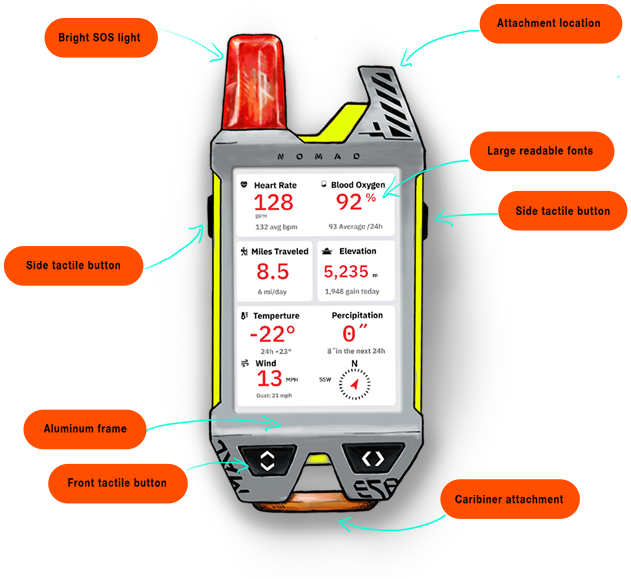
The device itself had to respect reality. Cold temperatures. Gloves. Goggles. Fatigue. Wind. Low visibility. A touch screen full of tiny interface elements wouldn’t survive that environment. So the interface became bold. Large. High contrast. The navigation relied on physical buttons that could be pressed with gloves on. The form was rugged, weatherproof, built to clip onto gear with carabiner-sized attachment points. It would hang inverted while attached, rotating upright naturally when lifted to read. Small details, but grounded in actual use.
Battery life couldn’t be an afterthought. It needed intelligent sleep modes, long endurance, and even the possibility of motion-assisted charging. And if something went wrong, it needed to be obvious. A bright red 360-degree beacon. Visible. Unmistakable.
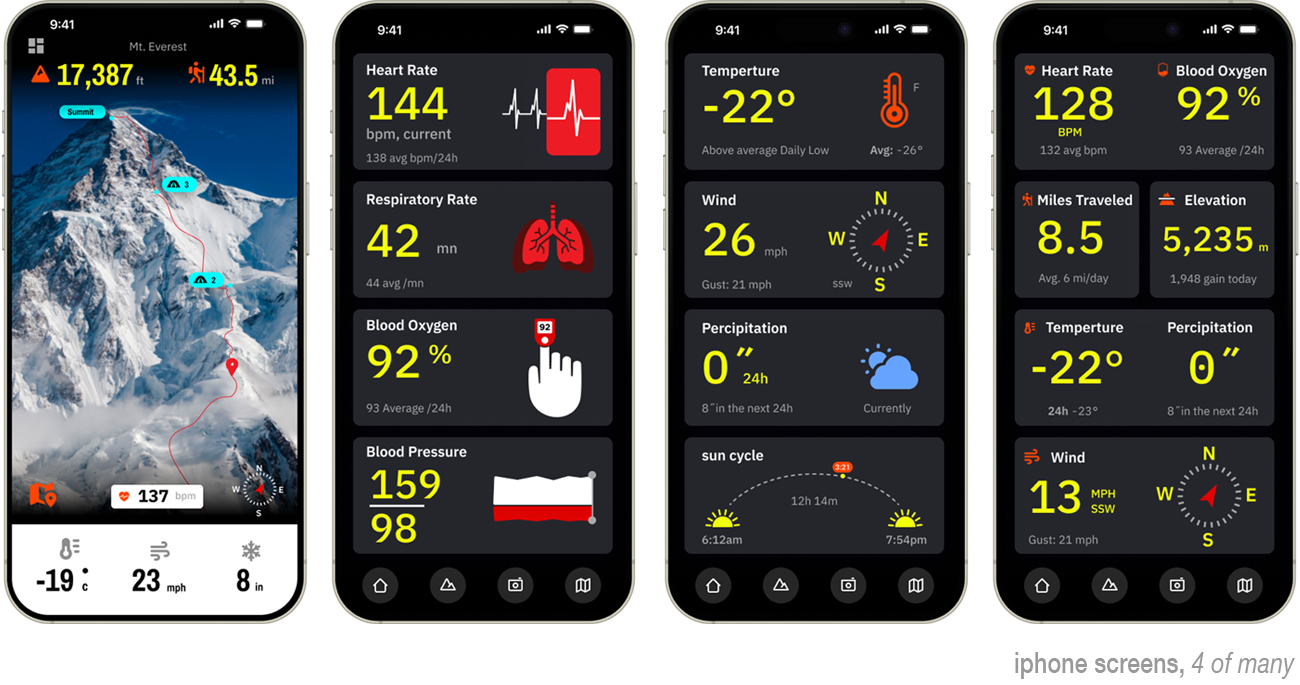
A medical-grade adhesive patch would pair with the device, monitoring heart rate, blood oxygen, respiratory rate, blood pressure, and motion. At high elevations, oxygen deprivation isn’t theoretical. It’s measurable. Instead of waiting for symptoms to become obvious, Nomad would track physiological signals in real time.
Layered over that was terrain intelligence, GPS, elevation, route tracking, weather conditions, forecasting, environmental alerts. The human body and the surrounding environment viewed together, not separately.
On guided expeditions, leaders could see where every member was. A designated medical lead could monitor individual vitals. Proximity awareness would reduce the risk of separation. After the trip, data could be reviewed, how the body responded to the climb, how performance changed with elevation, how terrain impacted fatigue.
The emergency logic reflected that shift. Instead of relying solely on a manual SOS button, the system could trigger an alert automatically if biometric anomalies paired with abnormal motion. In extreme conditions, someone may not be able to call for help. The system needed to recognize that.
As the concept evolved, it became clear that mountaineering was only the beginning. The core capability, synchronizing human state, environmental data, and location. Itcould extend into fishing, search and rescue, field research, endurance sports. Even a simplified mobile version could serve those who didn’t need the full hardware system but connected to the brand.